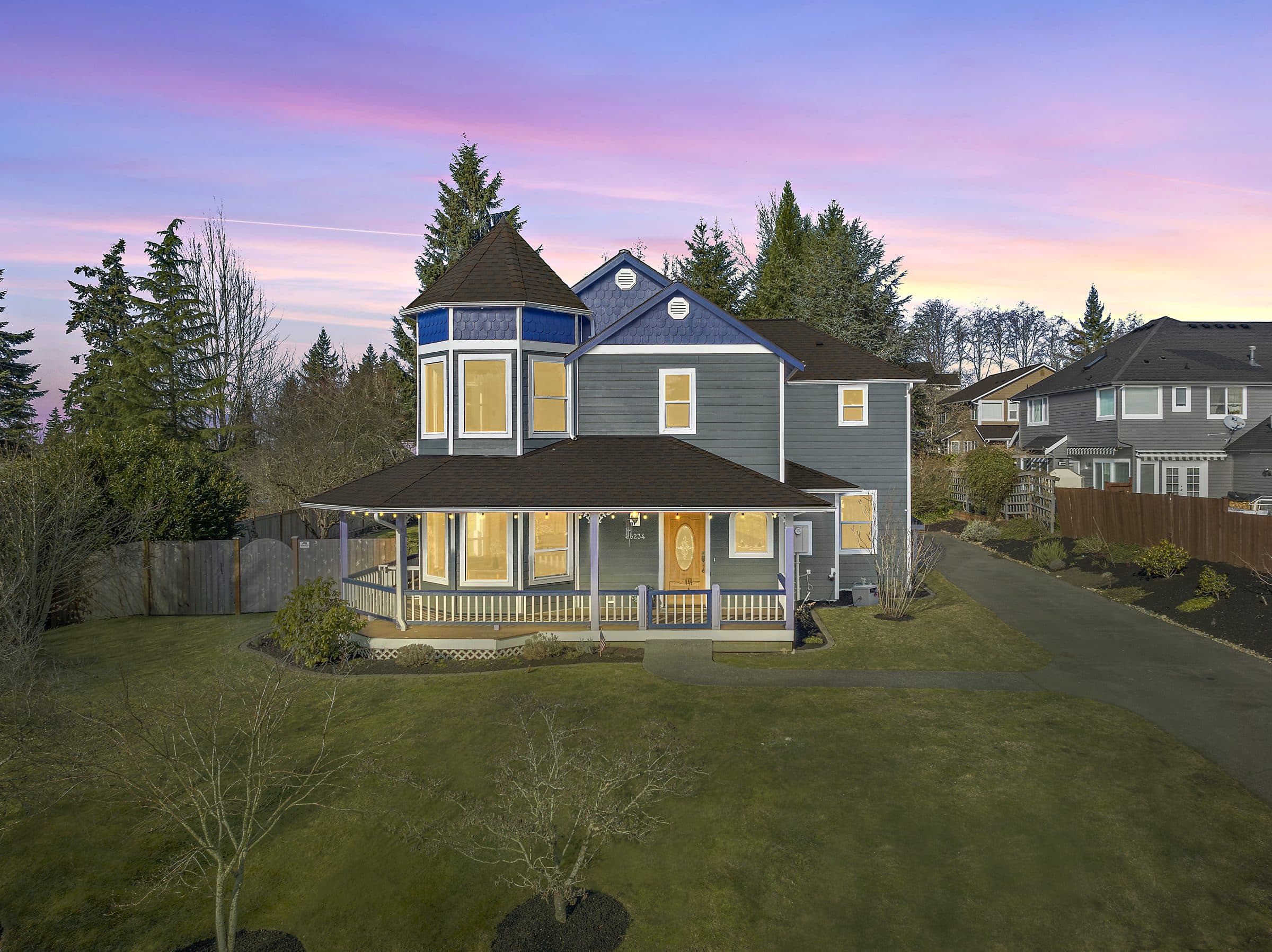

Puyallup is one of those cities that people think they understand before they've actually spent time there. They picture the Fair (fair enough, pun intended) and maybe South Hill traffic, and they leave it at that. But when I bring buyers here for the first time, I watch the same thing happen over and over: they turn a corner into downtown, see the antique shops and the farmers market pavilion, and go quiet for a second. It's not what they expected.
So, I've been working Pierce County real estate for over 15 years, and Puyallup is one of the cities I show buyers most often. It's not because it's trendy. It's because it actually delivers on a lot of fronts at once: a train to Seattle, walkable pockets, newer construction if you want it, older homes with real character if you don't, and a price point that still makes sense compared to King County.
Here's the thing though: Puyallup isn't one neighborhood. It's several, and they don't feel alike. South Hill and downtown Puyallup could almost be different cities. So before you fall for a listing photo, let's go through what living here is actually like, block by block, with real numbers.
What Are the Different Neighborhoods in Puyallup?
I always tell buyers the same thing about Puyallup: don't judge the whole city by the first neighborhood you drive through. It's genuinely three different experiences.
South Hill is the newer, higher-elevation part of Puyallup, and it's where most of the city's recent growth has happened. This is where you'll find newer construction, larger subdivisions, and the major shopping corridor around South Hill Mall along Meridian Avenue. If you want a Target run, a chain restaurant, or a big grocery store five minutes from home, South Hill has it covered. Homes here tend to sit at higher price points, especially newer builds, and that's reflected in the market data below. It's a car-dependent area for sure. You're driving to most things, not walking. But the trade-off is space: bigger lots, newer floor plans, and a lot of buyers are willing to make that trade.
Downtown Puyallup is a totally different feel. This is the historic core of the city, and it's genuinely walkable in a way that a lot of Pierce County doesn't offer. Older homes with actual character (think early to mid-1900s construction, front porches, mature trees), a compact commercial core, and the antique district I'll get into below. If you want to park your car on a Saturday and not need it again until Monday, downtown is where that's possible.
East Puyallup has more of a rural feel. Lots are larger out here, the density drops, and the area transitions gradually toward Orting and Sumner. It's a good fit if you want some breathing room without leaving Puyallup entirely, and I've had buyers find real value in this part of town simply because fewer people think to look there first.
What Makes Puyallup's Downtown So Special?
Honestly, this is my favorite part of the city to show buyers, and I say that as someone who has walked it more times than I can count.
The antique district is the anchor. It's a three-block stretch just north of the fairgrounds with more than seven shops packed into that small footprint. 3rd Street Antiques is the big one: about 15,000 square feet with roughly 80 individual vendors under one roof. It's the kind of place where you go in for one thing and leave two hours later with a lamp you didn't know you needed. Pioneer Antique and King's Row round out the district with their own personalities, and the shops rotate inventory often enough that regulars keep coming back week after week. If you've ever lost a Saturday to browsing (I absolutely have, more than once), downtown Puyallup is going to be a problem for your schedule.
Then there's the Puyallup Farmers' Market, which runs Saturdays from 9am to 2pm, April through October, at the Pioneer Park Pavilion at 330 S Meridian. It's a real market, not a small pop-up. Produce, flowers, baked goods, prepared food, local crafts. On a nice Saturday it feels like the whole downtown funnels through that pavilion at some point.
What ties it together is the historic character. The buildings downtown weren't built in the last decade, and it shows in a good way: brick storefronts, older architecture, a scale that feels like an actual town center instead of a strip mall. If walkability and neighborhood feel matter to you as a buyer, downtown Puyallup is worth spending an entire afternoon in before you make any decisions.
What About the Puyallup Fair?
You can't write about this city without addressing the Fair. It would be like writing about Tacoma and skipping the waterfront.
The Washington State Fair, still called "The Puyallup" by basically everyone who grew up here, runs September 4 through 27, 2026. It draws over 900,000 visitors most years, which makes it one of the largest fairs in the entire country. It's been running since 1900, so we're talking about a tradition that predates almost everything else in this city.
For buyers, here's what actually matters: yes, there's real traffic and congestion around the fairgrounds during those three or so weeks in September. If you're looking at a home close to the fairgrounds, I'd encourage you to drive that neighborhood during Fair season before you commit, just so you know what you're signing up for. It's not subtle.
But I also think it's worth saying the Fair brings something to this community that's hard to put a price on. It's part of the local identity. Neighbors talk about it, kids grow up going every year, and for three weeks the whole city becomes this regional destination. Some residents love that energy. Others would rather live further from the fairgrounds and skip the parking headache entirely. Both are completely reasonable positions, and it's just a matter of knowing yourself as a buyer.
What's the Housing Market Like in Puyallup Right Now?
Let's get into the numbers, because I think buyers deserve real data instead of vague vibes.
Citywide, the median home price in Puyallup is running between $565,000 and $625,000. On South Hill specifically, the median sits closer to $569,000 to $605,000, and that segment has actually seen about 7.7% year-over-year growth, which tells you newer construction in that part of town is holding demand well.
Price per square foot across the city runs roughly $260 to $284, depending on the neighborhood and the age of the home. Days on market currently range from about 21 to 43 days, so pricing and season both matter a lot here. It's a sellers' market right now: homes are closing at around 98.9% of asking price on average, which is close enough to full price that overpricing a listing doesn't really work anymore. Inventory is sitting at about 1.9 to 2.9 months of supply, which is tight. For buyers, that means you need to move decisively when the right home comes up. For sellers, it means a well-priced, well-presented home is still going to generate real interest.
Puyallup's population is around 44,000 people, which puts it at a size where it still functions like a real city (services, infrastructure, its own identity) without feeling like you've disappeared into a much larger metro area.
What Are the Schools in Puyallup?
The Puyallup School District covers an area of roughly 54 square miles, which includes most of South Hill and downtown along with surrounding areas. Depending on exactly where a home sits, especially in East Puyallup, you may actually fall within the boundaries of the Sumner-Bonney Lake School District instead. That boundary line matters, and it doesn't always follow the neighborhood lines you'd assume.
I verify exact school assignment for every property my buyers are seriously considering, because assuming based on the city name alone can lead to a surprise after closing. If schools are a factor in your decision, I'd always recommend confirming boundaries directly and visiting the specific campuses that would apply to a given address, since that's information I can help you track down as part of your search.
How's the Commute From Puyallup?
This is genuinely one of Puyallup's strongest selling points, and it surprises a lot of buyers who assume Pierce County automatically means a rough commute.
To Tacoma: about 15 to 20 minutes by car, depending on which part of Tacoma you're headed to and the time of day.
To Seattle by train: this is the big one. The Sounder S Line runs directly from Puyallup Station to Seattle's King Street Station, and the ride takes about 50 minutes. The station itself has 1,044 parking spaces, so getting a spot generally isn't the obstacle it is at some other stations. You get on, you sit down, and 50 minutes later you're downtown without having touched I-5. For buyers commuting into Seattle, that changes the whole calculation on whether Pierce County is even feasible.
To Joint Base Lewis-McChord (JBLM): roughly 25 to 30 minutes, which matters a lot given how many military-connected buyers I work with in this part of the county.
By bus: Sound Transit's ST 578 route also connects Puyallup to Seattle, though it's a longer ride at around 1 hour and 10 minutes. It's a solid backup option if the Sounder schedule doesn't line up with your hours, but for most commuters the train is the faster and more predictable choice.
What Parks and Outdoor Spaces Does Puyallup Offer?
Puyallup has more park variety than most buyers expect going in.
Bradley Lake Park is a 59-acre park built around a 12-acre lake, and it's one of my favorites to point buyers toward. It offers trout fishing from March through May, along with walking paths and picnic space around the water. It has that tucked-away feeling even though it's surrounded by neighborhoods on all sides.
Clarks Creek Park is a larger, more forested space with trails that follow the creek corridor. It's a good spot if you want a quieter walk with some wildlife along the way, and it feels distinctly different from the more developed parks in the system.
DeCoursey Park is the community-facing park: tennis courts, ball fields, and a playground. It gets steady use, and it's the kind of park that anchors a neighborhood rather than just decorating it.
Pioneer Park, downtown, does double duty. It's home to the farmers market pavilion, and it also has the Kiwanis Kids Spray Park for warmer months. Between the market, the antique district next door, and the spray park, this one green space carries a lot of downtown's community activity.
What Are the Pros and Cons of Living in Puyallup?
I give every buyer the honest version of this list, not the marketing version.
Pros:
Puyallup sits in a genuinely central location within Pierce County, with reasonable access to Tacoma, JBLM, and points further south. The Sounder gives you a real, functional way to commute into Seattle without owning your commute on I-5. The neighborhoods are distinct enough that you actually have choices: newer construction on South Hill, historic character downtown, more space out east. There's a strong sense of community character here, built around the antique district, the farmers market, and yes, the Fair. And compared to King County, you're still getting meaningfully more home for your money.
Cons:
Fair traffic is real for about three weeks every September, especially near the fairgrounds. South Hill's Meridian corridor gets congested, particularly around the shopping areas during peak hours, so I'd recommend driving it at rush hour before committing to a home in that area. And in some of the older parts of the city, infrastructure hasn't been fully modernized, which is worth factoring into your inspection expectations if you're buying a home with some age on it.
What Community Resources Should Puyallup Buyers Know About?
Here's a list worth bookmarking once you're seriously considering a move here.
- Puyallup City Hall: 333 S Meridian, (253) 841-4321, puyallupwa.gov
- Puyallup Public Library: 324 S Meridian
- Puyallup Parks & Recreation: puyallupwa.gov
- Puyallup School District: puyallupsd.org
- Washington State Fair: thefair.com (September 4-27, 2026)
- Puyallup Farmers' Market: puyallupfarmersmarket.com, Saturdays 9am-2pm, April through October, at Pioneer Park Pavilion
- Sound Transit Sounder, Puyallup Station: soundtransit.org
Is Puyallup Right for You?
So, is Puyallup the right move? Honestly, it depends less on the city itself and more on which part of it fits how you actually live. A buyer who wants newer construction and easy shopping access is going to feel very differently about South Hill than a buyer who wants to walk to a farmers market on Saturday mornings and browse antique shops in the afternoon. Both are valid. They're just not the same house search.
That's really the whole point of this guide: Puyallup isn't one thing, and treating it like one thing is how buyers end up in the wrong neighborhood for their actual life.
If you're thinking about a move to Puyallup, or anywhere else in Pierce County, I'd love to talk through what you're looking for and whether it's a fit. No pressure, no pitch. Just a straightforward conversation about your search and what buying here actually looks like right now.
Becca Pitts is a licensed real estate agent with eXp Realty LLC, SRES certified, specializing in Pierce County WA real estate. With 15+ years of experience and 270+ closings, she brings a detail-oriented, people-first approach to helping buyers find the right home in the right neighborhood.
Rebecca Pitts is a licensed real estate broker in Washington State, affiliated with eXp Realty LLC. License #107351. eXp Realty LLC is a licensed Washington real estate firm. Equal Housing Opportunity.